

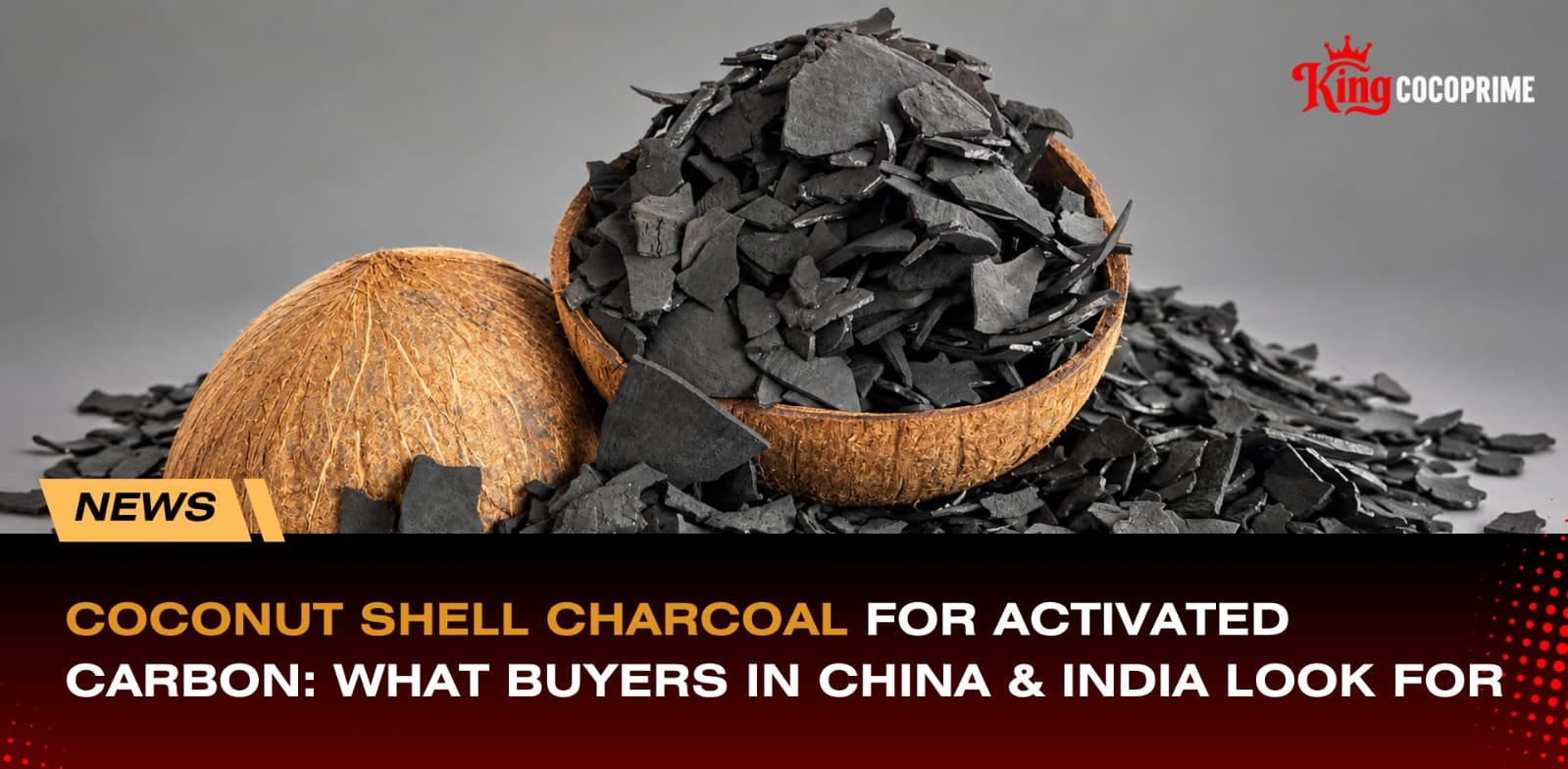
COCONUT SHELL CHARCOAL FOR ACTIVATED CARBON: WHAT BUYERS IN CHINA & INDIA LOOK FOR
When people hear coconut shell charcoal, they often think about shisha or BBQ charcoal.
But there is another market where coconut shell charcoal plays a very different role.
Activated carbon.
Behind the activated carbon industry is a global supply chain that depends on suitable carbon-rich raw materials. Coconut shell charcoal is one of the materials used as feedstock for producing activated carbon, making its quality, consistency, and availability important to industrial buyers.
And as international demand for coconut shell charcoal continues to develop, buyers in markets such as China and India are actively looking for reliable sources.
Why Is Coconut Shell Charcoal Used for Activated Carbon?
Coconut shells can be carbonized to produce a carbon-rich material that can subsequently be processed into activated carbon.
Activated carbon is widely used in applications including water purification, air filtration, industrial treatment, and other adsorption processes.
For manufacturers, however, the process begins with the right raw material.
That is why industrial buyers do not simply ask:
"How much does the charcoal cost?"
They also ask:
"What is the quality of the charcoal, and will it remain consistent from one shipment to the next?"
Industry and supplier specifications commonly focus on parameters such as fixed carbon, ash, moisture, volatile matter, particle size, and the degree of carbonization. :contentReference[oaicite:1]{index=1}
China and India Are Important Markets to Watch
China and India are both significant participants in the wider coconut charcoal and activated carbon supply chain.
Current buyer-market data shows active sourcing interest for coconut shell charcoal in both countries. Recent trade listings include Chinese buyers looking for coconut shell charcoal from Indonesia and Indian buyers requesting natural coconut shell charcoal for regular supply. :contentReference[oaicite:2]{index=2}
This is important because industrial buyers often require a much more consistent supply than buyers purchasing charcoal for occasional retail or food-service use.
For an activated carbon manufacturer, the raw material becomes part of an ongoing production system.
A single container may not be the goal.
Reliable monthly supply can be.
What Do Activated Carbon Buyers Look For?
There is no single specification that applies to every activated carbon manufacturer. Different factories may require different feedstock characteristics depending on their activation process and final product.
However, several parameters are commonly discussed when buyers evaluate coconut shell charcoal.
- Fixed Carbon – An important indicator of the carbon content of the material.
- Ash Content – Lower ash can be important for applications where mineral residue needs to be controlled.
- Moisture Content – Excessive moisture can affect handling, storage, transportation, and the effective dry weight of the shipment.
- Volatile Matter – An important parameter for evaluating the degree and consistency of carbonization.
- Particle Size – Buyers may require specific lump, granular, or screened sizes depending on their processing system.
- Carbonization Quality – Buyers may look for material that is fully carbonized and free from excessive unburned shell or inconsistent pieces.
- Foreign Matter – Stones, soil, metal, and other contaminants can create problems during industrial processing.
These specifications should always be agreed between the buyer and supplier before a commercial order is confirmed.
Fixed Carbon Is Not the Only Number That Matters
One common mistake when buying coconut shell charcoal is focusing on a single specification.
A supplier may advertise high fixed carbon, but that number alone does not describe the complete quality of an industrial shipment.
Imagine two suppliers offering charcoal with similar fixed carbon.
One shipment has consistent sizing, low ash, controlled moisture, and uniform carbonization.
The other contains a large amount of fines, inconsistent pieces, uncarbonized shell, or foreign material.
On paper, the fixed carbon number may look similar.
In production, the two materials may behave very differently.
This is why experienced industrial buyers usually evaluate a complete specification rather than relying on one number.
Why Consistency Can Be More Important Than the First Price
Price naturally matters in international commodity trading.
But for a manufacturer that consumes hundreds of tons of raw material, supply consistency can become equally important.
If the specification changes significantly from one shipment to another, the buyer may need to adjust production parameters, perform additional testing, or deal with unexpected processing results.
For this reason, serious buyers often look beyond the first quotation.
They want to understand:
- Where does the raw material come from?
- How is the coconut shell carbonized?
- What is the normal monthly production capacity?
- Can the supplier maintain the agreed specification?
- Can the supplier provide a COA or laboratory analysis?
- Can samples be tested before a large order?
- Can the supplier support long-term monthly requirements?
Why Indonesia Attracts International Buyers
Indonesia has a large coconut-based agricultural industry and an established ecosystem for coconut shell charcoal production.
This gives international buyers access to suppliers capable of offering coconut shell charcoal in bulk for different industrial applications.
Historical industry data also shows Indonesia as a significant exporter of coconut shell charcoal. A Coconut Development Board publication, for example, recorded Indonesia among the leading exporting countries in historical global shell-charcoal trade data. :contentReference[oaicite:3]{index=3}
Today, Indonesian suppliers continue to market coconut shell charcoal internationally for applications including activated carbon production and other industrial uses. :contentReference[oaicite:4]{index=4}
For buyers in China and India, Indonesia can therefore represent an additional sourcing origin when they are looking for reliable coconut shell charcoal supply.
Bulk Supply Is a Different Business
There is a major difference between selling several bags of charcoal and supplying an industrial buyer.
An industrial buyer may require:
- Regular monthly shipments
- Consistent specifications
- Container-scale loading
- Quality documentation
- Pre-shipment inspection
- Stable communication
- Reliable production planning
- Long-term supply agreements
For this reason, a supplier's ability to produce consistently can be just as important as the product itself.
Current international buyer listings illustrate the scale of this market. Recent requests include buyers seeking hundreds of tons of coconut shell charcoal and specifications covering fixed carbon, ash, moisture, volatile matter, size, and contamination limits. :contentReference[oaicite:5]{index=5}
What Should China and India Buyers Ask Before Ordering?
Before committing to a large shipment, buyers should clearly communicate their required specification.
A practical inquiry should include:
- Required quantity per month
- Required fixed carbon
- Maximum ash content
- Maximum moisture
- Volatile matter requirement
- Required particle or lump size
- Packaging preference
- Destination port
- Required shipping term
- COA and testing requirements
The clearer the specification, the easier it becomes for both buyer and supplier to determine whether the material is suitable.
The Opportunity Behind the Charcoal Supply Chain
The activated carbon industry creates an important opportunity for coconut-producing countries.
Instead of viewing coconut shell only as agricultural waste, the shell can become a valuable carbon-based industrial raw material after proper processing.
That creates a connection between two very different industries:
Coconut production → Coconut shell → Carbonization → Coconut shell charcoal → Activation → Activated carbon → Industrial applications
For international buyers, this means sourcing the right coconut shell charcoal is an important part of building a dependable raw material supply chain.
Looking for Coconut Shell Charcoal from Indonesia?
King Cocoprime supplies coconut shell charcoal from Indonesia for international buyers looking for bulk and export supply.
For industrial requirements, buyers can discuss their required specifications, monthly quantity, packaging, destination port, and quality documentation directly with our team.
Whether you are an activated carbon manufacturer, industrial buyer, distributor, or trading company, the right specification should always be confirmed before a commercial order is placed.
Looking for a reliable coconut shell charcoal supplier in Indonesia?
Contact King Cocoprime to discuss your requirements.