

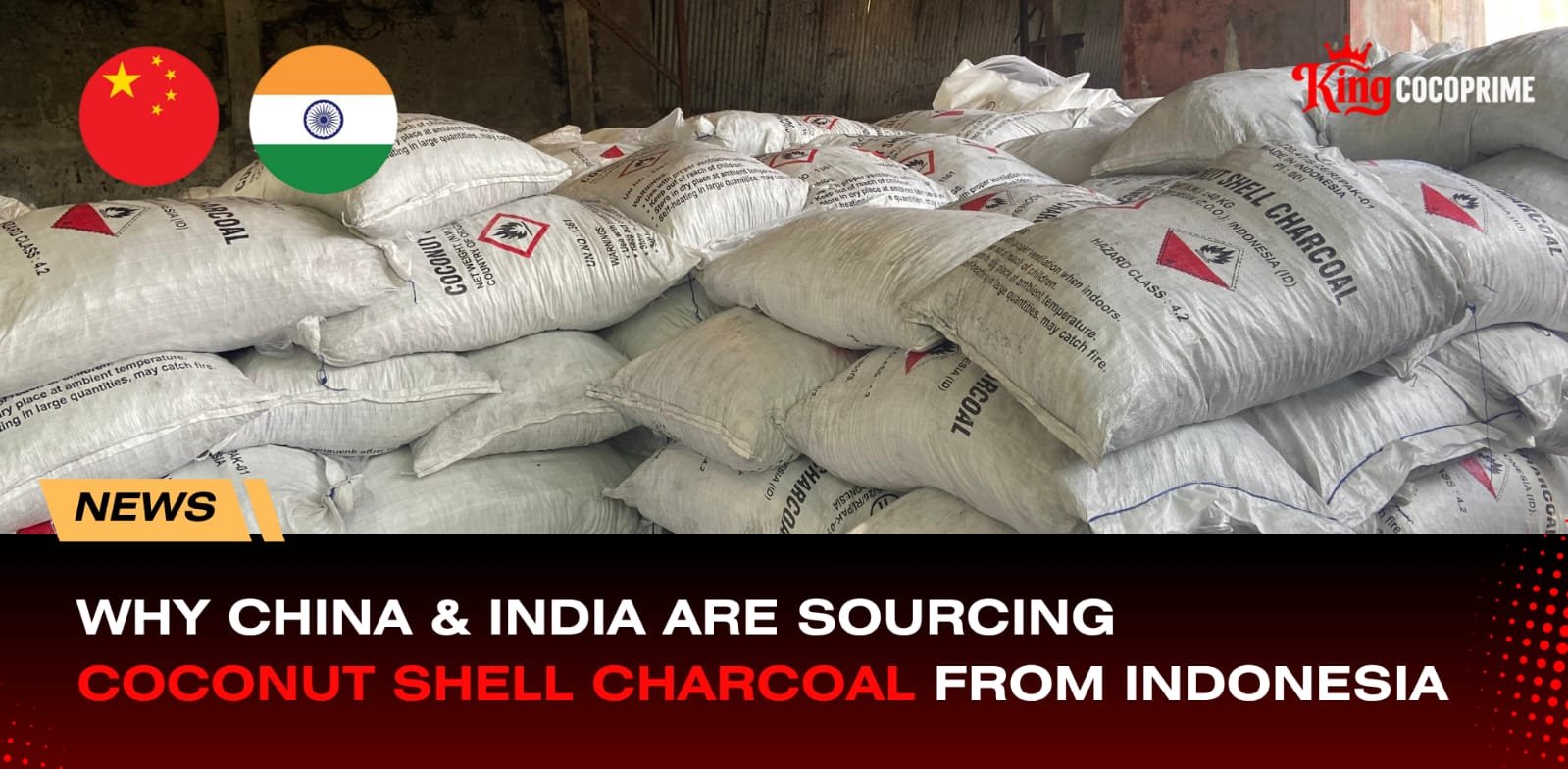
WHY CHINA & INDIA ARE SOURCING COCONUT SHELL CHARCOAL FROM INDONESIA
Something is changing in the coconut shell charcoal market.
Across Asia, buyers are looking beyond traditional supply channels as demand for coconut shell charcoal used as a raw material for activated carbon continues to create pressure on supply.
Among the markets paying close attention are China and India — two major industrial markets where coconut shell charcoal can become an important feedstock for activated carbon production.
And increasingly, international buyers are looking toward one country:
Indonesia.
Why Is Coconut Shell Charcoal Becoming So Important?
Coconut shell charcoal is more than a fuel product.
For the activated carbon industry, coconut shell charcoal can serve as an important carbon-rich raw material. Coconut shells are carbonized before being processed further into activated carbon through industrial activation processes.
Because activated carbon is used in applications such as water treatment, air purification, industrial processing, and other filtration systems, manufacturers need a stable and consistent source of suitable carbon feedstock.
This creates a very different type of demand from the shisha and BBQ charcoal markets.
Industrial buyers are not simply looking for charcoal.
They are looking for reliable raw material that can support continuous production.
China and India Are Looking for Reliable Supply
China and India have large industrial manufacturing ecosystems, and both countries are important participants in international trade.
Recent trade and market data also show significant activity involving coconut shell charcoal and activated carbon across Asian markets. Industry trade reporting in September 2026, for example, identified Indonesia as an increasingly important origin for coconut shell charcoal entering Asian activated-carbon feedstock markets. :contentReference[oaicite:1]{index=1}
Indonesia's broader export relationship with China and India is also significant. According to Indonesia's Central Statistics Agency (BPS), China and India were among Indonesia's largest non-oil and gas export destinations in early 2026. :contentReference[oaicite:2]{index=2}
For industrial buyers, however, the challenge is not simply finding a country that produces coconut shell charcoal.
The real challenge is finding a supplier capable of delivering the right quality, volume, consistency, and supply continuity.
Why Are Buyers Looking Toward Indonesia?
Indonesia has one of the world's largest coconut industries, creating a significant base of coconut shell raw material.
When properly processed and carbonized, coconut shells can become a valuable carbon-rich material for industrial applications.
This creates several advantages for international buyers.
- Abundant coconut shell raw material
- Established charcoal production infrastructure
- Competitive production costs
- Large-scale export capability
- Access to international shipping routes
- Experience supplying overseas industrial buyers
For buyers searching for coconut shell charcoal suppliers in Indonesia, these factors can make Indonesia an attractive sourcing destination.
The Real Problem: Volume
For activated carbon manufacturers, purchasing a few tons of charcoal is very different from securing a continuous industrial supply.
Some industrial purchasing requirements can reach hundreds of tons per month. In market inquiries and sourcing discussions, monthly requirements of approximately 300–500 MT are not unusual for buyers seeking to secure sufficient raw material for ongoing production.
This changes the question from:
"Who sells coconut shell charcoal?"
to:
"Who can supply the quantity we need every month without compromising quality?"
Quality Matters More Than Just Price
When coconut shell charcoal is intended for industrial processing, buyers need to evaluate more than the price per metric ton.
Depending on the intended activation process and buyer specification, important parameters can include:
- Fixed carbon
- Ash content
- Moisture content
- Volatile matter
- Particle or lump size
- Foreign matter
- Carbonization consistency
Different activated carbon manufacturers may require different specifications. Therefore, industrial buyers should always agree on product specifications and testing requirements before establishing a long-term supply program.
Why International Buyers Search Beyond Their Local Market
One of the biggest challenges in industrial production is maintaining a stable supply of raw materials.
If a factory depends on a raw material that becomes difficult to source locally, production planning can become more complicated.
This is one reason international buyers may travel across countries and regions searching for alternative sources.
They are not necessarily looking for the cheapest charcoal.
They are looking for a supply chain they can depend on.
For a factory consuming hundreds of tons of raw material every month, an inconsistent supplier can create a much larger problem than a small difference in purchase price.
Indonesia's Opportunity in the Activated Carbon Supply Chain
The growing attention toward coconut shell charcoal creates an opportunity for Indonesian producers and exporters to move beyond traditional charcoal markets.
Instead of focusing only on finished briquettes for shisha or BBQ applications, Indonesian suppliers can also serve industrial buyers looking for coconut shell charcoal as activated carbon raw material.
This opens another international market for Indonesian coconut shell charcoal.
And the opportunity is not limited to one country.
China and India are important markets to watch, while other Asian industrial markets are also involved in the broader coconut shell charcoal and activated carbon supply chain.
What Should Buyers Look for in an Indonesian Supplier?
Before placing a large order, industrial buyers should evaluate several factors.
- Raw material origin – Confirm that the charcoal is produced from coconut shell.
- Quality consistency – Ask for product specifications and laboratory testing where required.
- Monthly production capacity – Confirm whether the supplier can support the required volume.
- Supply continuity – A supplier should have a reliable sourcing and production system.
- Packaging and loading – Bulk packing and container loading should match the buyer's logistics requirements.
- Export experience – International documentation and shipping coordination are important for long-term trade.
- Pre-shipment inspection – Buyers may request quality inspection before loading.
The Search for Indonesian Coconut Shell Charcoal Is Becoming More Industrial
The coconut shell charcoal market is no longer only about shisha and BBQ charcoal.
Behind the visible charcoal market is another industrial supply chain — one connected to activated carbon production.
As manufacturers continue to search for reliable carbon-rich raw materials, Indonesian coconut shell charcoal is attracting attention from buyers looking for competitive pricing, scalable supply, and suitable industrial quality.
For Indonesian producers, this represents an important opportunity.
For international buyers, it raises an important question:
Can your current supplier provide the volume you will need next month — and the month after that?
Looking for Coconut Shell Charcoal from Indonesia?
King Cocoprime supplies Indonesian coconut shell charcoal and coconut charcoal products for international buyers seeking reliable export supply.
For industrial requirements, product specifications, bulk orders, and long-term supply discussions, buyers can contact our team to discuss their required quality, quantity, packaging, and destination.
Looking for a reliable coconut charcoal supplier in Indonesia?
Talk to our export team and discuss your requirements directly.